


How to convert article to podcast: a step-by-step creator’s guide
Practical guide to convert article to podcast with multi-voice AI. Templates, prompts, editing checks, distribution tips, and a GoCrazyAI workflow.
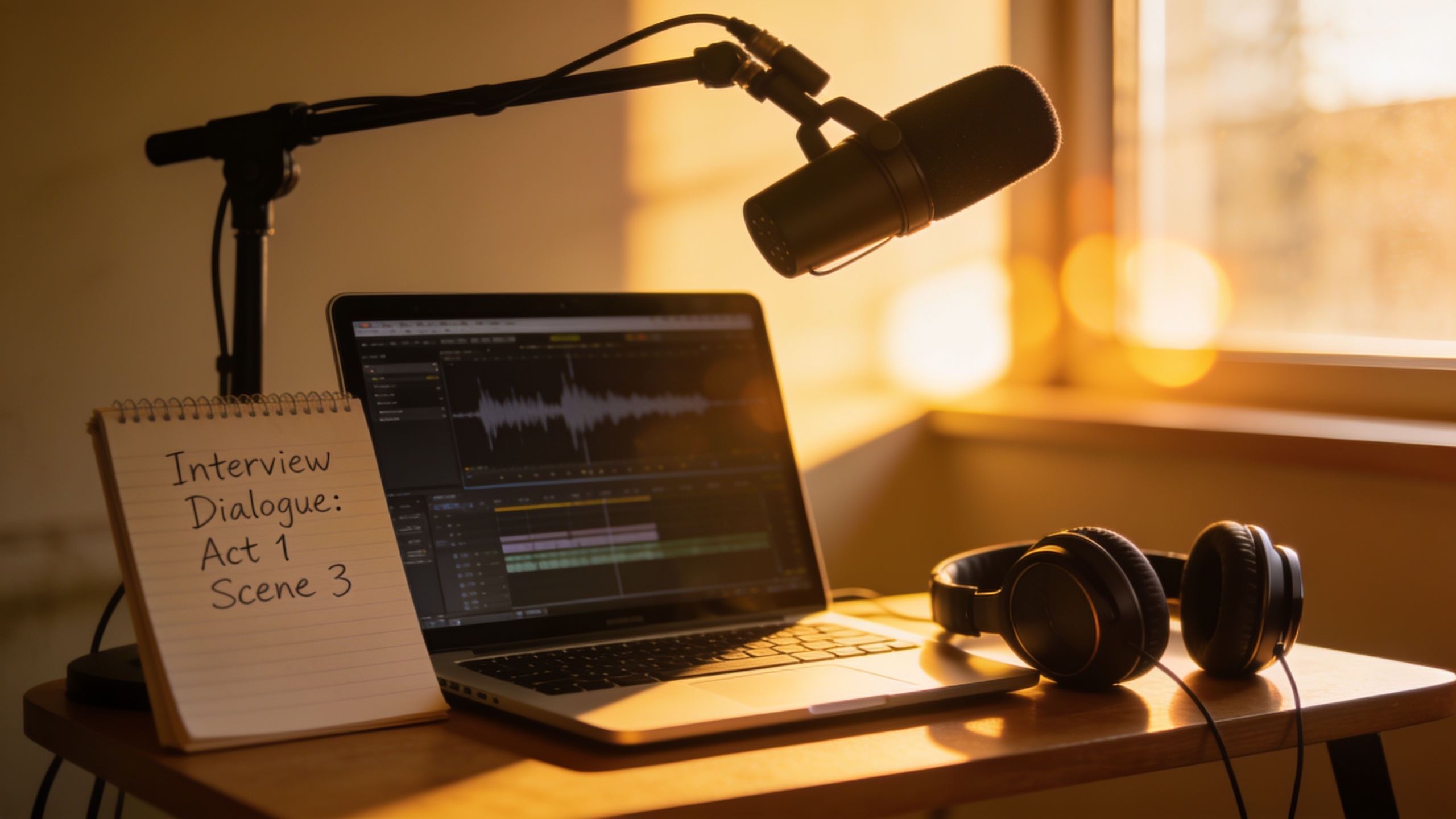
You want to convert article to podcast quickly and reliably so your writing reaches listeners as episodes, not just web pages. This guide walks through a reproducible editorial workflow: picking the right posts, reshaping them into an audio script, assigning voices, generating a mixed episode, and publishing with show notes and transcripts. It includes concrete prompts, quality checks, and distribution tactics you can copy immediately.
I'll show options that produce a publish-ready multi-voice episode in minutes once templates are in place and explain where to pause for human review. One hands-on section covers the GoCrazyAI AI Podcast Generator so you can test the end-to-end flow on your first article.
Quick Answer
How do you convert article to podcast? Edit the article into a short conversational script, assign roles and timing, generate multi-voice audio with an AI podcast tool, then review and export an MP3/WAV with timestamps and a transcript. With templates and GoCrazyAI’s AI Podcast Generator, you can often create a publish-ready two-host episode in under 10 minutes.
Why Publishers Should Convert Articles to Podcasts Now (audience growth & ROI)?
Podcast listening still grows and converting written articles into audio meets readers where they already spend time. Edison Research’s The Podcast Consumer (2024) documents long-term increases in time spent with podcasts and continued audience expansion, which means offering audio versions can reach a larger, often more engaged audience[1].
For publishers, audio versions extend asset life: a single article becomes an episode, show notes, social clips, and transcript-based posts. This increases ROI because the same core idea is repackaged for different channels. Practically, you should prioritize posts that have stable relevance and can be condensed to a clear 8–20 minute episode. That matches typical consumption patterns and reduces production complexity.
Choosing the Right Articles to Repurpose: editorial criteria that work for audio?
Choose articles that have clear narrative arcs, defined sections or list structures, and either evergreen utility or recent relevance. In most cases, these types convert best to audio: how-to guides, explainers, product roundups, interviews, and listicles.
Editorial criteria that work:
- Clear structure: headings that map to episode segments.
- Strong hook: an opening paragraph that can be read as a 15–30 second intro.
- Length: aim for source articles that can be edited into 800–2,000 words for 8–20 minute audio.
- Freshness check: update statistics and time-sensitive references before generating audio to avoid outdated claims (quick refresh is standard practice[2]).
If you have analytics, prioritize posts with high pageviews, high time-on-page, or existing social traction. Those indicate an audience you can convert to listeners with relatively low risk.
Preparing your article for audio: script editing, pacing, and conversational structure (example prompts included)?
To convert article to podcast, you must turn prose into something that sounds natural when spoken. Reduce sentence length, add verbal signposts, and create explicit cues for speakers.
Example editing checklist:
- Break long paragraphs into 1–2 sentence bites.
- Convert lists into spoken bullets: name the item, then explain in 1–2 sentences.
- Add brief transitions and cues like “Host:” or “Guest:” to mark turns.
- Insert timing notes (e.g., "pause after this sentence — 0.5s") for natural flow.
Example prompt (use with an AI assistant to rewrite a blog section into a podcast script):
"Rewrite the following 400-word blog section into a 90–120 second conversational script for two hosts. Keep short sentences, add a 15-second cold open hook, and insert speaker labels Host A and Host B. Preserve facts but simplify technical terms. Output only the script."
Example output snippet:
Host A: "Today we’re breaking down three budget tricks any freelancer can use. First—track your time."
Host B: "Yep — and I’ll explain a quick method I use to bill accurately."
These kinds of prompts produce scripts that map directly to multi-voice generation tools.
Hands-on: Create a multi-voice episode from a blog post using GoCrazyAI AI Podcast Generator?
You can convert an article to podcast on GoCrazyAI by feeding a script or topic prompt and assigning distinct voices to each role; the tool then generates a single mixed audio file ready for export. It supports generating multi-voice dialogue from one prompt and outputs an episode that can be dropped into your feed.
Step-by-step in GoCrazyAI:
- Open the AI Podcast Generator at the AI Podcast Generator page and choose "New Episode." (Use the AI Podcast Generator to start.)
- Paste your edited script or enter the article URL and choose "Script-to-Episode." The generator can create a multi-voice conversation from a topic prompt if you prefer to auto-generate a script.
- Assign roles: pick Host and Guest voices from the voice library. You can use natural-sounding options and set relative volumes.
- Set pacing and pauses: choose reading speed (typical: 0.95–1.05x) and enable short breathing pauses for realism.
- Preview a short clip, then generate the full mixed MP3/WAV. The system outputs a single mixed audio file and a transcript/timestamps for repurposing.
This workflow is built to get from script to mixed episode in minutes. For creator teams that need music beds or custom intros, pair the episode export with GoCrazyAI’s AI music generator and AI Voices features where needed. For voice design and clones, see the AI Voices library.
Helpful internal links: explore GoCrazyAI AI Voices for voice choices and the AI music tool if you want a theme bed.
You can try every step above directly in GoCrazyAI AI Podcast Generator — no setup needed.

Hands-on: Review, edit, and polish AI voices and dialogue for natural-sounding conversation (examples)?
A quick human pass usually catches unnatural phrasing, pacing problems, and incorrect emphasis. Review the generated audio and transcript while listening for places that sound "robotic" or where phrasing would confuse a listener.
Quick review routine (10 minutes):
- Listen to the first 60–90 seconds while reading the transcript. Mark timestamps where delivery feels off.
- Check for mispronounced names, acronyms, or numbers in the transcript and correct them in the script source.
- Adjust voice mix: lower the background voice by 1–3 dB if overlapping lines feel crowded. Add micro-pauses (0.2–0.6s) between turns for clarity.
- Re-generate small segments after edits rather than the whole episode when possible.
Example prompt for rewording a line to sound natural:
"Rewrite this sentence so two hosts can say it naturally in casual conversation: 'Implementing a content repurposing workflow increases ROI by leveraging existing assets.'"
Example reply: "Host A: 'We repurpose stuff so it lasts longer. Host B: 'Yeah—so one blog can turn into five pieces of content. It's smarter.'"
For complex corrections, use granular editing tools in the AI Podcast Generator to reassign text to a different voice or tweak speed and pitch per segment.
Distribution and repurposing: publishing the episode, show notes, transcripts, and content recycling?
Publish the episode to your host with a full set of outputs: the mixed MP3/WAV, a cleaned transcript with timestamps, and concise show notes. These assets let you reuse the episode as social clips, short-form videos, and SEO-friendly blog updates.
Essential distribution checklist:
- Export a high-quality MP3 (128–192 kbps) or WAV for hosting.
- Use the provided transcript to create show notes and chapter markers. Timestamps help listeners and editors.
- Clip 30–60 second highlights for social platforms; add captions created from the transcript.
- Update the original blog post with an embedded player and a brief summary linking to the episode.
Transcription speeds repurposing: modern tools reduce manual transcription time and let you generate multiple content pieces from one episode quickly, making the repurposing 5-step workflow (select, adapt, generate, publish, transform) a practical way to increase lifetime ROI[3].
Measuring success and scaling a blog-to-podcast workflow with automation (common pitfalls to avoid)?
Measure listens, completion rate, and where users drop off; pair those stats with traffic and social metrics from the original article to judge ROI. For scaling, automate steps like transcript generation, episode tagging, and social clip extraction, then use templates for script rewriting and voice assignments.
Common pitfalls and how to avoid them:
- Mistake: Converting every article without selection. Avoid: prioritize high-value posts and those that map cleanly to audio.
- Mistake: Skipping fact checks on older posts. Avoid: add a quick 'update references' step before generation (update numbers, dates, and links).
- Mistake: Overusing one voice or lacking contrast between hosts. Avoid: pick distinct voices and test volumes to maintain clarity.
- Mistake: Publishing without a transcript or show notes. Avoid: always attach a transcript and short notes for SEO and accessibility.
When you standardize templates and add small automation (auto-transcribe, auto-timestamp, scheduled publishing), you can reliably produce many episodes per week without proportional increases in team hours. Track performance on key metrics and iterate on episode length, intro hooks, and clip selection to grow audience reach.
Frequently Asked Questions
How long does it take to convert an article to a podcast episode?
With a clear template and an AI podcast tool, end-to-end conversions often take under 10 minutes for a short episode; full human review and tweaks add another 10–30 minutes depending on complexity[4].
Do I need to hire voice actors to make a multi-voice podcast?
No. Modern AI podcast tools let you assign distinct AI voices for hosts and guests and export a mixed audio file. Human voice actors are optional when you want a specific branded voice.
How do I avoid sounding robotic when using AI voices?
Shorten sentences, add micro-pauses, correct pronunciations in the transcript, and tweak speed and pitch for specific segments. A short human review pass catches most unnatural spots.
Can I publish an AI-generated episode to my existing podcast feed?
Yes. Most tools export standard MP3/WAV files and transcript files that you can upload to any podcast host or use direct publishing features that some platforms provide.
Conclusion
Converting articles to podcast episodes is a high-leverage way to reach audio-first audiences and extend asset lifetime. Start by choosing the right posts, rewrite for listening, assign distinct voices, and run a brief quality pass before publishing. If you want a fast way to test the workflow, pick a topic in the AI Podcast Generator and you'll have a mixed episode in minutes.
Sources
- The Podcast Consumer 2024 by Edison Researchedisonresearch.com ↗
- Turn Your Blog Posts Into Podcast Episodes – WordPress.com News (Posts to Podcast)wordpress.com ↗
- Generate an AI podcast from your posts – WordPress.com Support (Posts to Podcast support doc)wordpress.com ↗
- How to Turn an Article Into a Podcast With AI (Step-by-Step Guide) | MuseFablemusefable.com ↗
- 5-Step Content Repurposing Workflow (2026 Guide) | Recast Studiorecast.studio ↗
- How to Turn Your Blog Into a Podcast in Under 10 Minutes Using AI | TheAILibrarytheailibrary.co ↗
- How to Turn a Blog Post Into a Podcast — Step-by-Step (2026) | PodGorillapodgorilla.co ↗
- Blog to Podcast Converter - Turn Articles into Audio | ScreenAppscreenapp.io ↗
- Turn Blog Posts Into Podcasts With AI — Step by Step | TextSpeakProtextspeakpro.com ↗
- How to repurpose podcasts and webinars into 10+ content pieces with AI transcription | Vocovavocova.app ↗