


Sukkot Kids Songs
Sukkot Songs for Kids
A holiday where you build a hut, decorate it with the kids' own art, and then eat dinner inside it — Sukkot was already the most kid-friendly week of the fall. Now it gets its own soundtrack, with your kids' names in it.
5 free songs with every account · no credit card required
Hear real examples
Every track below was generated with this tool — press play, then make yours.
Explain Sukkot to a four-year-old and watch their eyes go wide: we're building a little house in the yard, you get to decorate it, and then — this is the part that lands — we eat dinner inside it. The week practically writes its own songs, and now it can literally have them: a sukkah-building song with your kids' names on hammer duty, a lulav shake-along, a gratitude song for circle time, all generated in one to three minutes each. Everything here is written for the adults doing the planning — parents, morahs, youth directors — because Sukkot prep is a grown-up production performed for an audience of very short critics.
One thing this page says plainly, because observant families plan around it: generate everything before the chag. Many families don't use devices on yom tov, so the play is to make the songs the week before, learn them at pre-holiday circle time or during the build, and sing them live in the sukkah — which is how the best sukkah songs have always worked anyway. Teachers do the same for the classroom sukkah unit; the songs are ready before the first wall goes up. The lyric-sheet move works here too: print the words, tape them to a sukkah wall next to the paper chains, and the singing takes care of itself all week.
From prompt to sung lyrics
The sukkah-building song
Prompt: “A sukkah-building song for my kids — Eli hammers, Tova hangs the paper chains, everybody eats inside”
[Chorus]
We're building up a sukkah, wall by wall by wall,
Eli's got the hammer and he's helping Daddy haul,
Tova hangs the paper chains from one end to the other —
Tonight we're eating dinner in a hut we built together!
The lulav shake song
Prompt: “A lulav shake action song for preschoolers — shake it front, side, up and down, with the etrog held tight”
[Verse]
Hold your lulav nice and tall, the etrog in your hand,
Shake it out in front of you — now shake it to the side,
Shake it up and shake it down, then hug it in real close,
Four species all together — that's the Sukkot way to go!
Song ideas to start from
How it works
- 1
Describe your song
Type one sentence — the person, the story, the vibe — or start from an example above. Any language works.
- 2
Pick a style and length
Vocals or instrumental, any genre, from a 15-second hook to a full-length track. Or write every lyric yourself in the studio.
- 3
Generate, download, share
Your song renders in minutes with cover art and its own page. Download the MP3 or just send the link.
Sukkah-building songs: hammers, walls, and a hut you eat in
The build is the event. Kids who won't sit through anything will hand you tent poles for an hour, and a building song turns the job site into a singalong: a verse for the walls, a verse for the schach going on top, a verse for the moment somebody's drawing gets taped up, and a chorus about eating dinner in a hut we made ourselves. Put your kids' actual names on their actual jobs — Eli hammers, Tova hangs chains — and the song becomes the memory. A verse about the wobbliest wall being everyone's favorite is optional but strongly encouraged.
Generate it a few days early and play it during the build itself (Sukkot prep days are regular days), so by the first night everyone already knows the chorus and can sing it in the sukkah, no speaker required. Families who host a sukkah hop can send the song ahead — by the time the neighborhood arrives, three households already know the words.
Lulav shake songs: the four species as an action song
Preschool teachers figured this out long ago: the lulav is a ready-made action song. Shake it front, shake it to the side, up, down — little bodies love a song with choreography built in, and the motions help the sequence stick the way melody helps most things stick. Ask for explicit movement cues in the lyrics and a tempo slow enough for three-year-old arms, and you've got the centerpiece of your Sukkot circle time. Teachers stage it as a dry run with rolled-up paper lulavs, so the real four species meet little hands that already know the moves.
Name the four species in the lyrics — lulav, etrog, hadas, aravah, transliteration is exactly how kids' music handles Hebrew — and the vocabulary rides along with the shaking. Practice happens before the holiday; the shaking itself happens live, which is rather the point. A three-year-old who can shake on cue by the end of September is a three-year-old who owns the holiday.
Harvest and gratitude songs for circle time
Sukkot is the harvest festival, z'man simchateinu — the season of our joy — and the gratitude angle gives circle time its gentlest song of the fall. A popular format: a thankfulness song that names each child and one thing they said they're grateful for ("Noa's thankful for her savta, Ben is thankful for the rain"). Collect the answers on Monday, generate the song that night, and by the end of the week the class sings it from memory. Day school music teachers use the same trick for the harvest unit — apples, pomegranates, and the first fall rain all earn their verses.
Songs are private by default — a class list typed by a teacher is song content and nothing more, shared only with the families you choose to send the link to.
Decorating the sukkah: paper chains and the kids' art on the walls
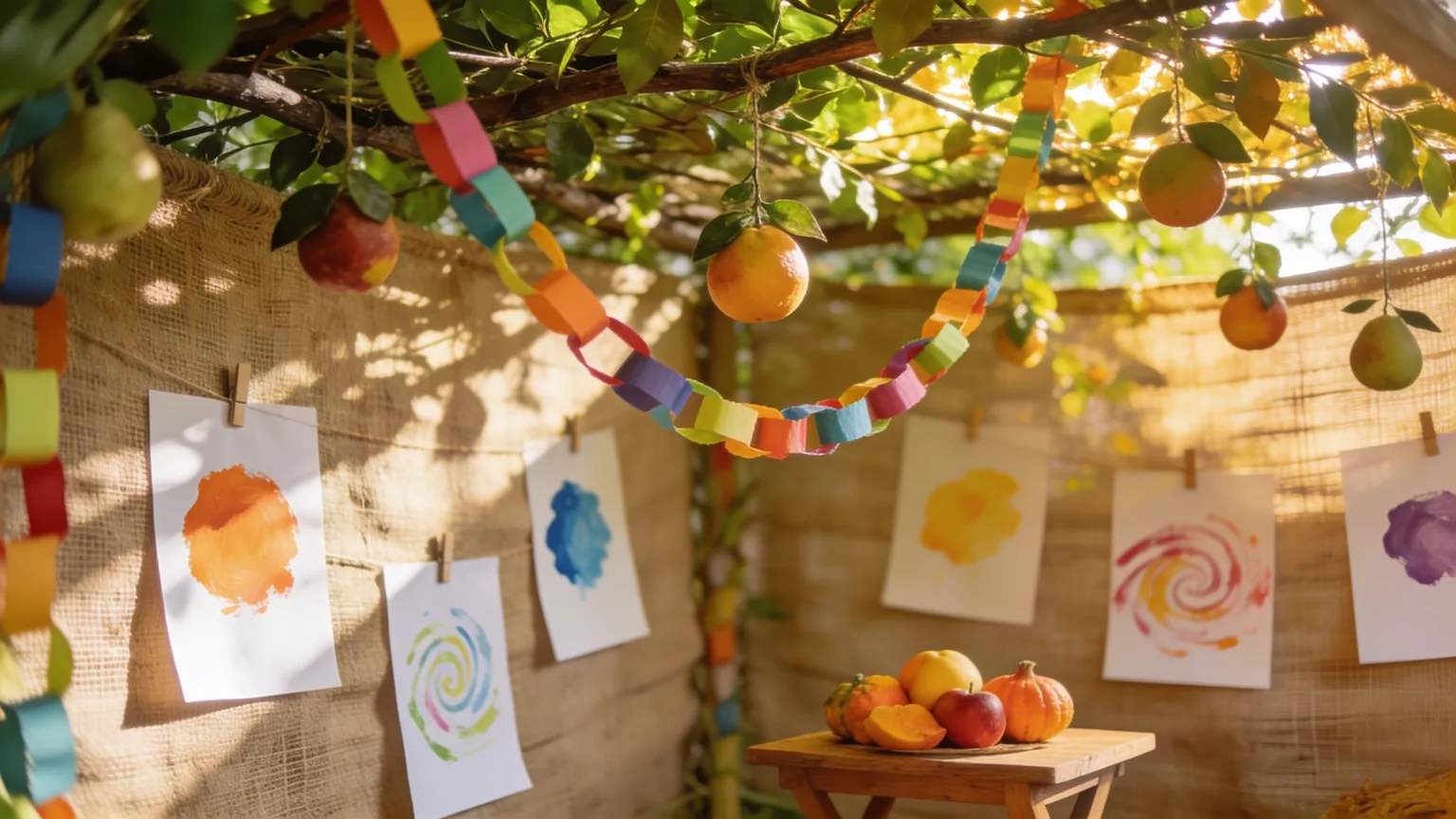
Decorating is the kids' department, and they know it. Paper chains measured in wingspans, hanging fruit, laminated drawings clothespinned to the walls — a decorating song makes an afternoon of it, with a verse per decoration and a chorus about making the sukkah beautiful for the guests. Ask for a verse about each child's contribution and the sukkah tour ("and THAT one's mine") gets its own theme music.
Families who make one keep remaking it: next year's version adds the new baby, the new drawings, the year it rained on the paper chains. Keep the MP3 in the same folder as the decoration box and the tradition reassembles itself every Tishrei — a small thing, started in three minutes, that compounds.
Frequently asked questions
Can the song include my kids' names and their jobs on the sukkah?
Yes — that's the best version of it. Name who hammers, who hangs the chains, who's in charge of taping up the drawings, and each kid gets their line. For exact control, paste your own words in Lyrics mode (up to 3,000 characters). Next year, regenerate it with the new baby added — the song grows with the family.
Can we play it in the sukkah on yom tov?
We'd never suggest it — many families don't use devices on yom tov, which is why this page frames everything as before-the-holiday prep. Generate early, learn it during the build or at circle time, and sing it live in the sukkah. On chol hamoed, families who play recordings can press play.
Is it free to make one?
Every new account includes 5 free songs, no credit card required. After that, songs cost 5 credits each — the free tier covers a building song, a lulav song, and a circle-time song with room to spare.
How long does a song take to generate?
One to three minutes per song. Even if the walls are already up, you have time to make the decorating song before the paper chains run out. Cover art generates automatically, so the song arrives ready to send to the grandparents.
Can the lulav song include the actual shaking motions?
Yes — ask for movement cues in the lyrics ("shake it front, now to the side, now up, now down") and a preschool-friendly tempo. Action songs with built-in choreography are exactly what this does well. Preschool teachers report the etrog-hug line is the crowd favorite; plan for encores.
Can it use Hebrew words like sukkah, lulav, and etrog?
Absolutely — transliterated Hebrew sings naturally, which is how US Jewish kids' music has always worked. Bilingual English-Hebrew verses are great for the gan; full Hebrew script works too if you paste it in Lyrics mode. Aim the vocabulary at your youngest singer and everyone else follows.
Will it teach my class the four species?
It helps the way melody has always helped memory — words set to a tune tend to stick, especially with motions attached. It's a joyful assist for your teaching, not a curriculum; the teaching itself is still yours. The same goes for ushpizin, schach, and the rest of the week's vocabulary — sung words simply get repeated more often than spoken ones.
Can the song be in my own voice?
Yes — Your Voice mode sings the song in your adult voice from about fifteen seconds of you talking, no singing needed. It's the parent's or teacher's voice, always — a building song sung by Abba himself is the keeper. Voice songs cost 10 credits and the voice clone is auto-deleted after the render. Kids' voices are never cloned — the mode is for the grown-ups.
The song has my students' names in it — is it public?
No. Songs are private by default; you get the MP3 and a private song page link to share with class families. Publishing to the community is optional and entirely your call.
Can I make an instrumental version for a slideshow of the build?
Yes — Instrumental mode generates the music with no vocals, which suits a photo montage of the build for the grandparents. Songs run 15 seconds to several minutes, so match it to your slideshow. The vocal version doubles as the soundtrack when the grandparents come see the finished sukkah in person.
Takes about a minute to start. 5 free songs included.