


Seder-Ready Songs
Passover Songs for Kids
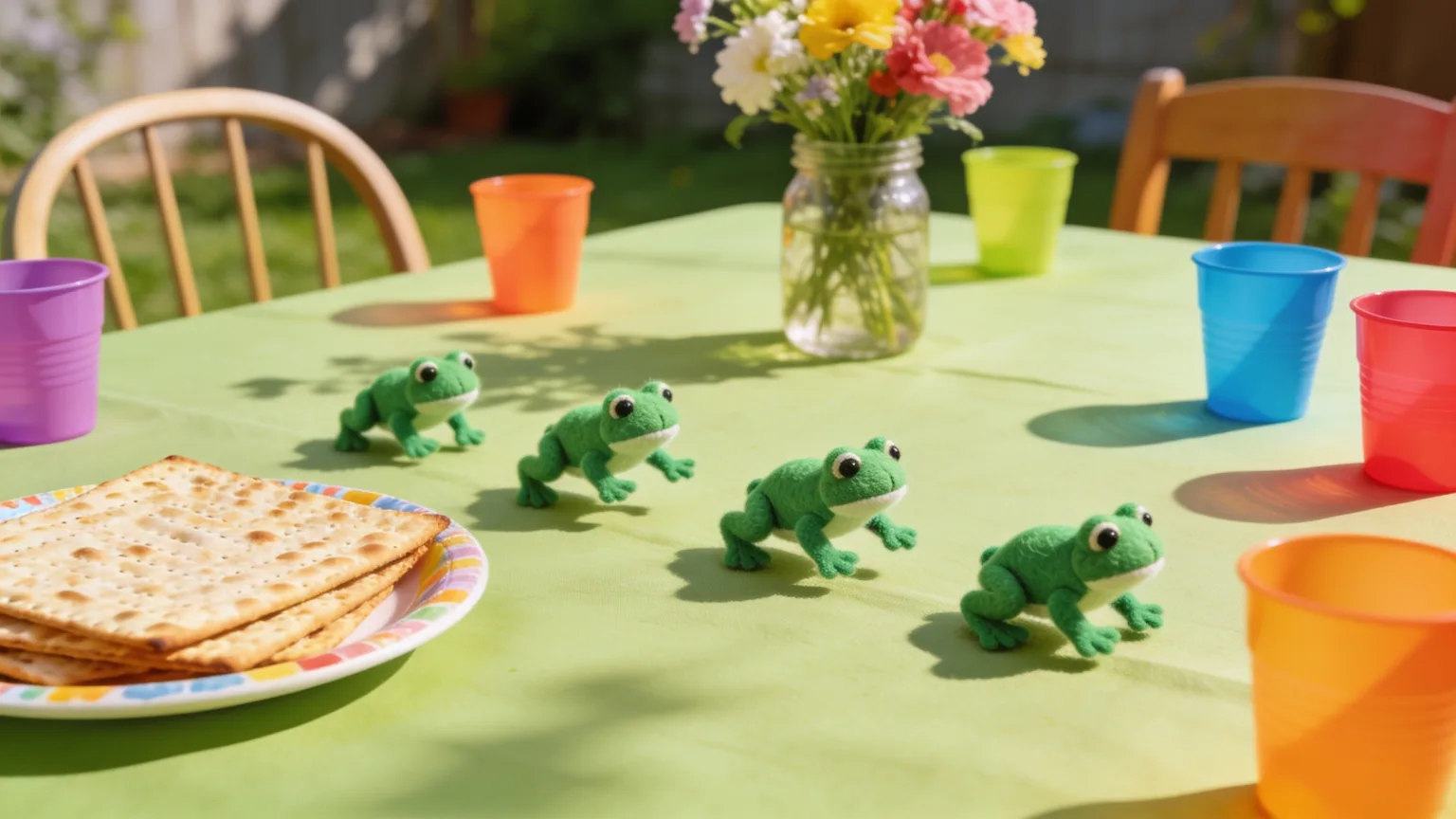
The youngest child has one big moment at the seder — Ma Nishtana — and weeks to get ready. A practice song, a family seder song, and a few frogs make the getting-ready the fun part.
5 free songs with every account · no credit card required
Hear real examples
Every track below was generated with this tool — press play, then make yours.
Passover hands kids the best role in the entire Jewish year: the youngest at the table stands up, every adult goes quiet, and one small voice asks the four questions. It is a big moment for a four-year-old — thrilling and a little scary in exactly the way big moments are — which is why the weeks before the seder are practice season in every Jewish home and classroom. A practice song, made just for your child with their name in the chorus, turns that rehearsal from a chore into the part they ask for at bedtime.
This generator writes original Passover songs for kids from a simple prompt: the Ma Nishtana practice song, a song about your family's particular seder with all its rituals and running jokes, a frog-and-plagues silly number for the preschool room, an afikomen-hunt anthem. Songs generate in one to three minutes, come with cover art and an MP3 download, and — since seder nights themselves are screen-free for many families — everything on this page is built for the joyful, busy weeks before the holiday, when the practicing happens.
From prompt to sung lyrics
The Ma Nishtana practice song
Prompt: “A gentle, encouraging practice song for Eli, age four, learning his four questions moment”
[Chorus]
Stand up tall, little Eli, the whole table waits for you,
Four small questions, one brave voice — you know just what to do,
Why is this night so different? You'll ask it loud and clear,
And every grown-up at the seder will be so glad you're here.
The frog song
Prompt: “A silly frog song for preschool circle time — frogs jumping absolutely everywhere”
[Verse]
One frog on the pillow, two frogs on the chair,
Frogs in Pharaoh's breakfast bowl and hopping down the stair,
Ribbit on the rooftop, ribbit on the floor —
Everywhere that Pharaoh looked, there were always more!
Song ideas to start from
How it works
- 1
Describe your song
Type one sentence — the person, the story, the vibe — or start from an example above. Any language works.
- 2
Pick a style and length
Vocals or instrumental, any genre, from a 15-second hook to a full-length track. Or write every lyric yourself in the studio.
- 3
Generate, download, share
Your song renders in minutes with cover art and its own page. Download the MP3 or just send the link.
Ma Nishtana practice: the youngest child's big moment
The traditional Ma Nishtana melody is the one your child will actually sing at the seder — it is taught in every Hebrew school and passed down at every table, and that is exactly as it should be. What a custom practice song adds is the runway: an original song, with your child's name in it, about standing up, being brave, and knowing what the four questions actually mean — why the matzah, why the dipping, why this night. It rehearses the moment, not just the words, which for a four-year-old is most of the work.
The honest, modest claim is the true one — melody helps memory, and a song a child loves gets played on repeat, which is what practice actually is. Prompt it with your child's name, their age, and one true detail ("she practices in front of the dog," "he wants to do it standing on his chair"), and play it in the car through the weeks of Nisan. By seder night the nerves have a soundtrack that says: you've got this. And when the small voice finally asks, the whole table gets the payoff — the grandparents especially, who have been waiting for this particular youngest child's turn since the seder plate was set.
Dayenu and the seder canon kids love
Some Passover songs need no help from anyone: Dayenu is the moment kids wait all seder for — fifteen verses of permission to be loud — and the closing set of Chad Gadya and Echad Mi Yodea is a call-and-response marathon children have adored for centuries. Those belong to the Haggadah and to your family's table, and this generator honors them by leaving them exactly where they are. Learn them from the people who love you; that is how they have always traveled, from one crowded table to the next, gaining a hand-motion here and a family flourish there along the way.
One honesty note for the shpiel-minded: we cannot generate soundalikes of existing tunes, traditional or copyrighted, so "Dayenu but our version" is not what this makes. What we make are original songs — new melodies, your words and details. For families who love writing their own parody verses for the seder, Lyrics mode will sing your exact words, up to 3,000 characters with [Verse] and [Chorus] tags, to a brand-new tune in whatever style you name.
A custom song about your family's seder
Every family's seder has its own mythology: Grandpa's wine-stained Haggadah, the afikomen hidden somewhere new each year, the cousin who always finds it, the great matzah-ball density debate, the pillow on the youngest chair. A song about your seder — names, rituals, running jokes — gives the kids a map of the night before they live it, and turns "how much longer?" into "is it the afikomen part yet?" For a first-seder toddler, hearing the night described in a song makes the long table feel like somewhere they already belong — the cups, the questions, the hunt, all previewed and demystified before the doorbell rings.
Parents make it in the week before the holiday and play it at breakfast, in the car, during the great chametz cleanup — which, incidentally, also goes better with a countdown song. Since many families put devices away once the holiday begins, the song's job is done by candle-lighting: by then the kids know the shape of the night by heart, and the seder itself gets their full, unplugged attention. Print the lyric sheet if the big kids want to keep singing at the table — paper travels into the holiday just fine, and a page of family lyrics next to the Haggadah is its own small tradition in the making.
Frogs, plagues, and the playful tradition
Jewish early education long ago figured out that the ten plagues, handled at preschool altitude, are irresistible to small children — hence the beloved frog songs, the finger puppets, the plague masks made of paper plates, the ping-pong-ball hail. It is a real tradition of keeping a heavy story light for little ears, refined over generations of Nisan mornings, and it works because kids meet the story at exactly the size they can hold.
Prompt a frog song with your class's name, a bouncy counting song about frogs in increasingly ridiculous places, or a gentle finger-puppet number that names the plagues and moves right along without dwelling. Keep the register silly and the tempo quick — this is circle-time energy, not a theology lesson, and the teachers who know the age group keep it exactly that light. A "frogs in Pharaoh's bed" verse has launched a thousand giggle fits; yours will too, and the kids will be croaking it at pickup, which is how a preschool unit announces success.
Frequently asked questions
Can the practice song use my child's name?
Yes — the name in the chorus is what makes a practice song work. "Stand up tall, little Eli" lands differently than a generic encouragement track, and kids play a song about themselves far more often, which is the practice doing itself. A name typed by a parent is simply song content, and songs are private by default.
Will it teach my child the actual Ma Nishtana melody?
No — the traditional melody belongs to your family, your Hebrew school, and the seder table, and that is where your child should learn it. Our practice song is the companion piece: an original song about the moment itself — the meaning of the questions and the courage to stand up and ask them.
Is it free to make one?
Every new account includes 5 free songs, no credit card required. After that, songs cost 5 credits each — the practice song, the frog song, and the family seder song fit comfortably inside the free five, with room to regenerate a favorite. Publishing a song to the community is optional and earns a free song, though most family songs stay private.
How long does a song take to generate?
One to three minutes. Even the week-before-Pesach panic window is plenty of time to make a practice song, hear it, and regenerate it once with a better detail about your kid. Each song arrives finished — cover art, MP3 download, and its own page.
Can the songs include Hebrew?
Yes — transliterated Hebrew ("ma nishtana," "afikomen," "matzah") sings naturally and is how American kids' Jewish music has always worked, so write it phonetically in the prompt. Ask for bilingual English-Hebrew verses if your classroom or family wants both languages trading lines, and keep the Hebrew phonetic in the prompt for the most natural delivery.
Are the plague songs appropriate for preschoolers?
That is up to your prompt, and the tradition is on your side: frog songs and finger-puppet numbers keep it silly and quick, exactly how Jewish preschools have always handled the plagues for this age group. Ask for "light, bouncy, preschool circle time" and that is precisely the song you get.
Can the song be in my voice for my child?
Yes — Your Voice mode sings the song in a parent's voice from about fifteen seconds of you talking (no singing required, 10 credits). The voice clone is deleted automatically after the render, and the song stays private by default. It is always the adult's voice — never a child's — and a practice song in Mom's voice is the keepsake version.
Can we play the songs at the seder itself?
For many observant families the seder nights are device-free, so these songs are built for before the holiday: practice weeks, car rides, the chametz-cleanup playlist. By candle-lighting the songs have done their job and live in the kids' heads — which is exactly where you want them when the youngest stands up to ask.
Can it write a song for our whole Hebrew school class?
Yes — a class seder-prep song with the teacher's name and every student worked into the verses is a spring favorite. Teachers play it in the weeks before Pesach, use it to rehearse the order of the seder, and send parents the song page link so the practicing continues at home.
What styles work best for kids' Passover songs?
Gentle acoustic for the practice song, bouncy singalong for frogs and afikomen hunts, klezmer-flavored for the culturally rich classroom, and something march-like for the cleanup countdown. Name a style in the prompt, or describe the mood — "brave and warm" or "maximum silly" — and the generator takes it from there. Songs run anywhere from 15 seconds to several minutes, so a quick transition jingle and a full seder-prep anthem are equally easy.
Takes about a minute to start. 5 free songs included.